

Product certification
Ergonomic products with the IGR seal of approval
Home » Certification » Product certification
Product certification
Ergonomic products with the IGR seal of approval
The quality of a product is of the utmost importance – all the more so if it is to maintain our health and alleviate physical complaints. However, as there are so many advertising promises, it is difficult for the consumer to make an informed purchasing decision in order to avoid disappointment. Established quality seals make orientation much easier by confirming the quality of a product and thus effectively dispel any doubts. In the case of ergonomically valuable products or services, such a quality feature is even more crucial, as the health of the user is at stake. With our product certification, we have committed ourselves to the goal of promoting greater transparency on the market.
The IGR "Ergonomic product" seal of approval - a reliable standard for tested ergonomics
The IGR “Ergonomic Product” seal of approval stands for tested ergonomic quality based on our minimum requirements and normative principles. As an independent institute with many years of experience in research, development and application of ergonomic standards in the field of occupational health management, we have certified numerous products from a wide range of industries in recent years.
Our testing follows established standards such as DIN EN ISO 26800 and EN ISO 15537, which define and test both the usability and the ergonomic fit of a product. This is not just about advertised properties or product promises, but about their actual ergonomic effect in practical use.
The trust of numerous manufacturers and specialist retailers who use our seal of approval for product labeling both nationally and internationally underlines the value of this certification. It serves as a guide for decision-makers and consumers who rely on comprehensible, practical ergonomics.
The seal of approval can be used in over 20 languages

The IGR quality certificates at a glance
In addition to our IGR seal of approval, our quality certificates serve to identify ergonomic quality. The test certificates and test results provide the end consumer with independent and valuable information about the product, which should help them to make a careful purchasing decision.
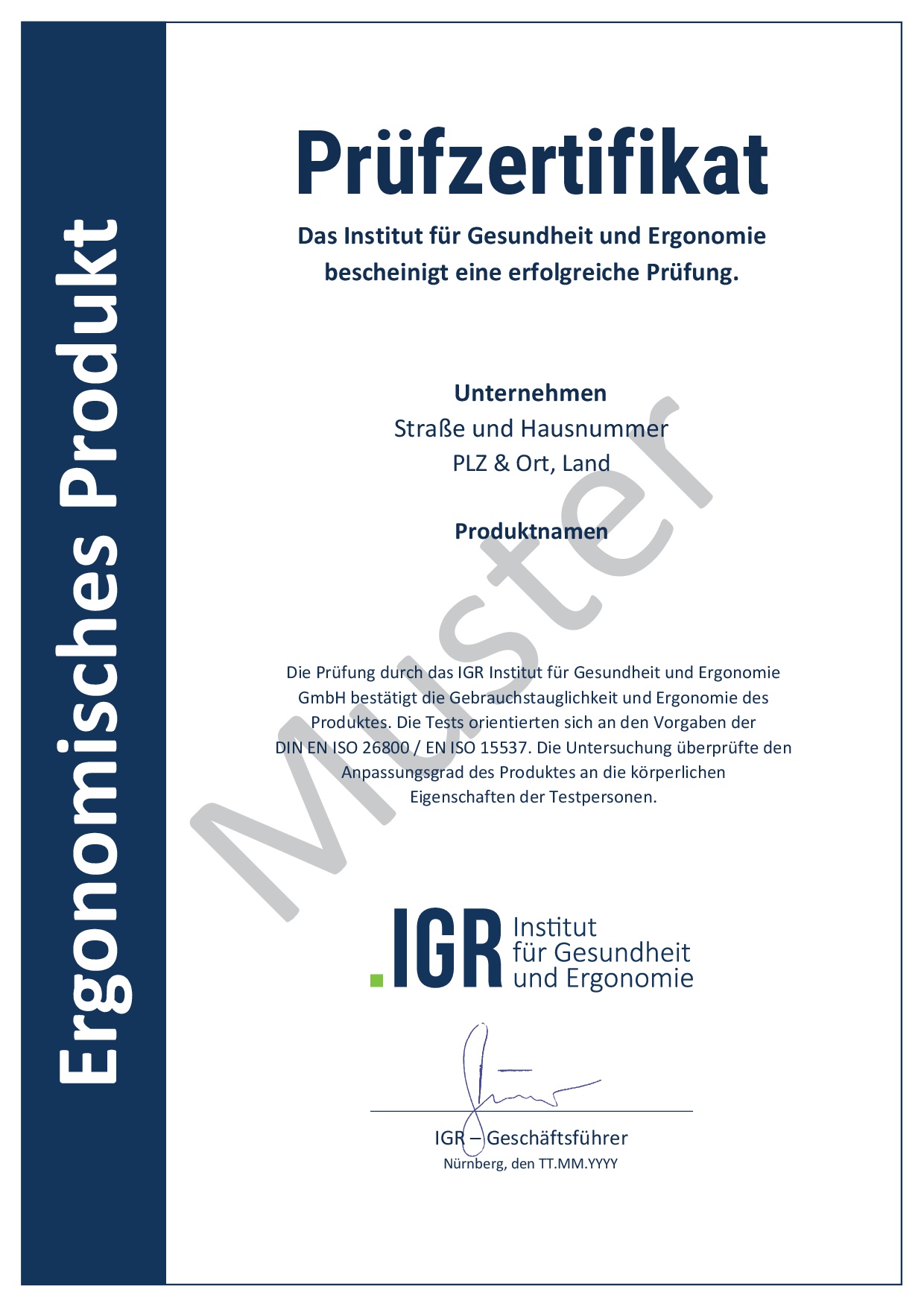
Our test certificate
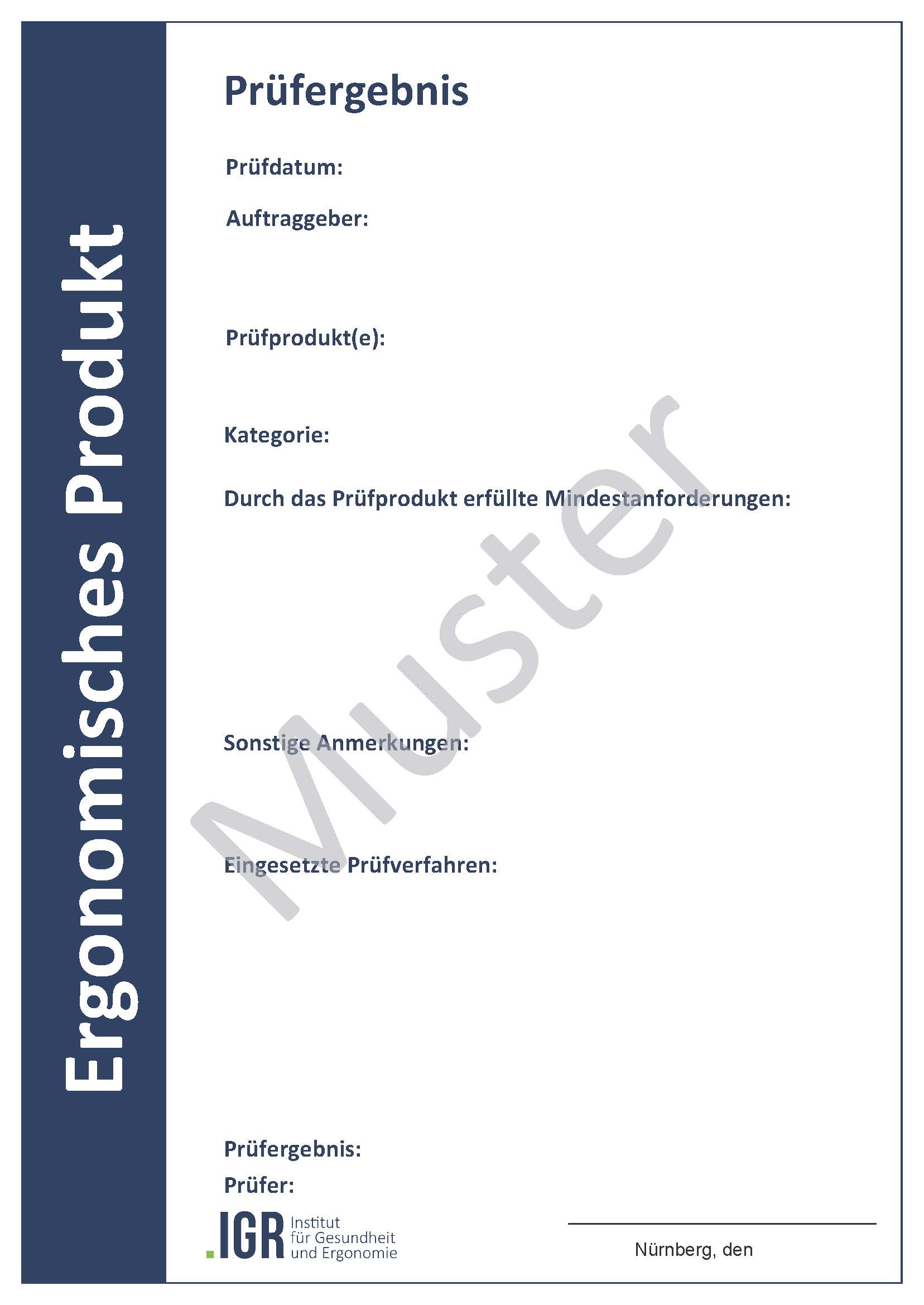
Our test results document minimum requirements and test procedures






How does certification at the IGR work?
The IGR certification process – transparent, structured, quality-assured
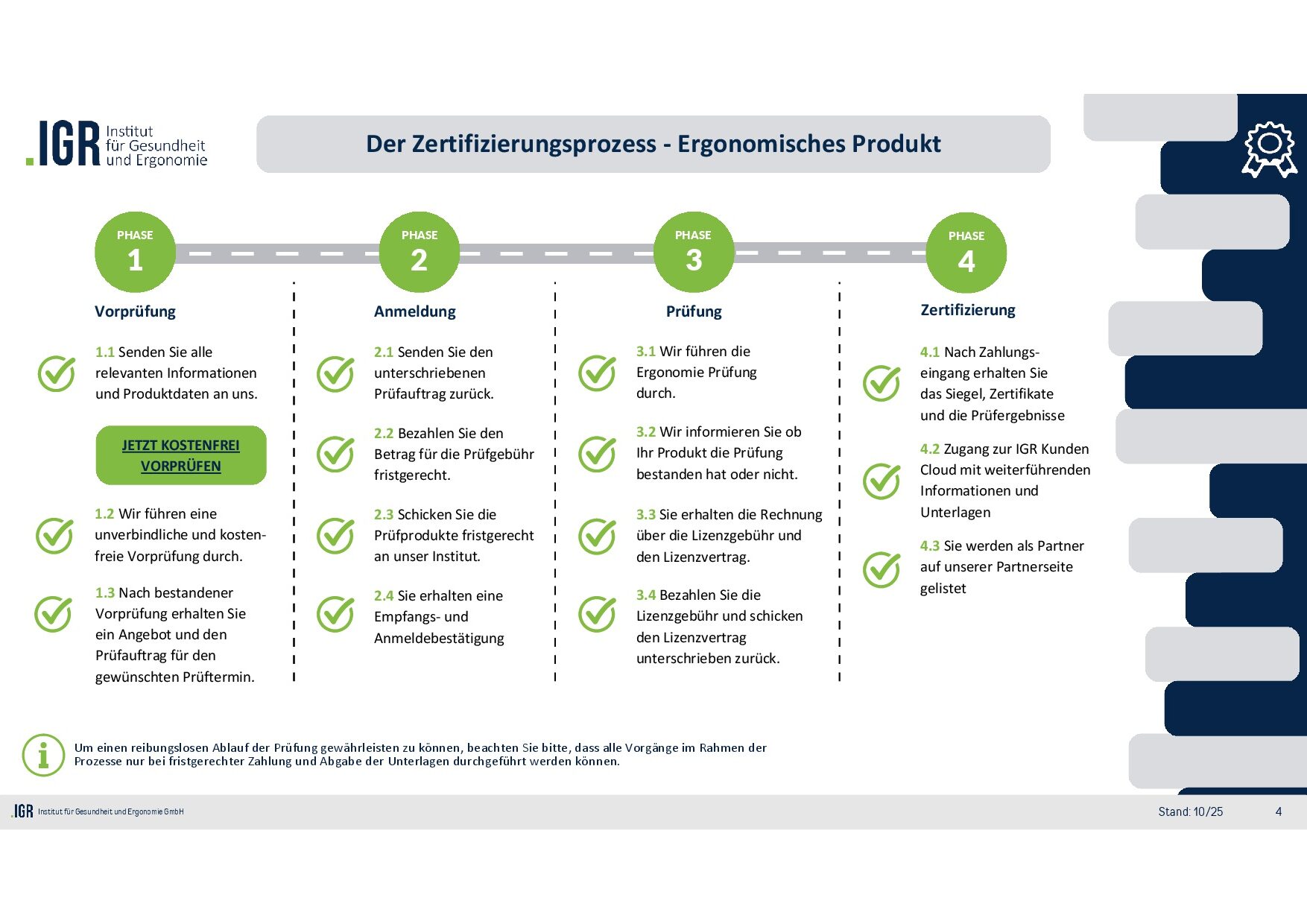
The certification of ergonomic products by the IGR – Institute for Health and Ergonomics – follows a clearly structured process based on transparency and quality assurance. The aim is to test products neutrally and comprehensibly under realistic conditions.
The first step is a free preliminary assessment. Interested companies send product information and data to the IGR, whereupon an initial assessment of basic suitability is carried out. If the assessment is positive, the company receives an individual offer and the test order.
The actual test is carried out in accordance with internationally recognized standards such as DIN EN ISO 26800 and DIN EN ISO 15537.
The entire process is designed to provide companies with practical support and to check ergonomic products for compliance with minimum requirements.
Our PDF provides you with a visually prepared step-by-step overview.
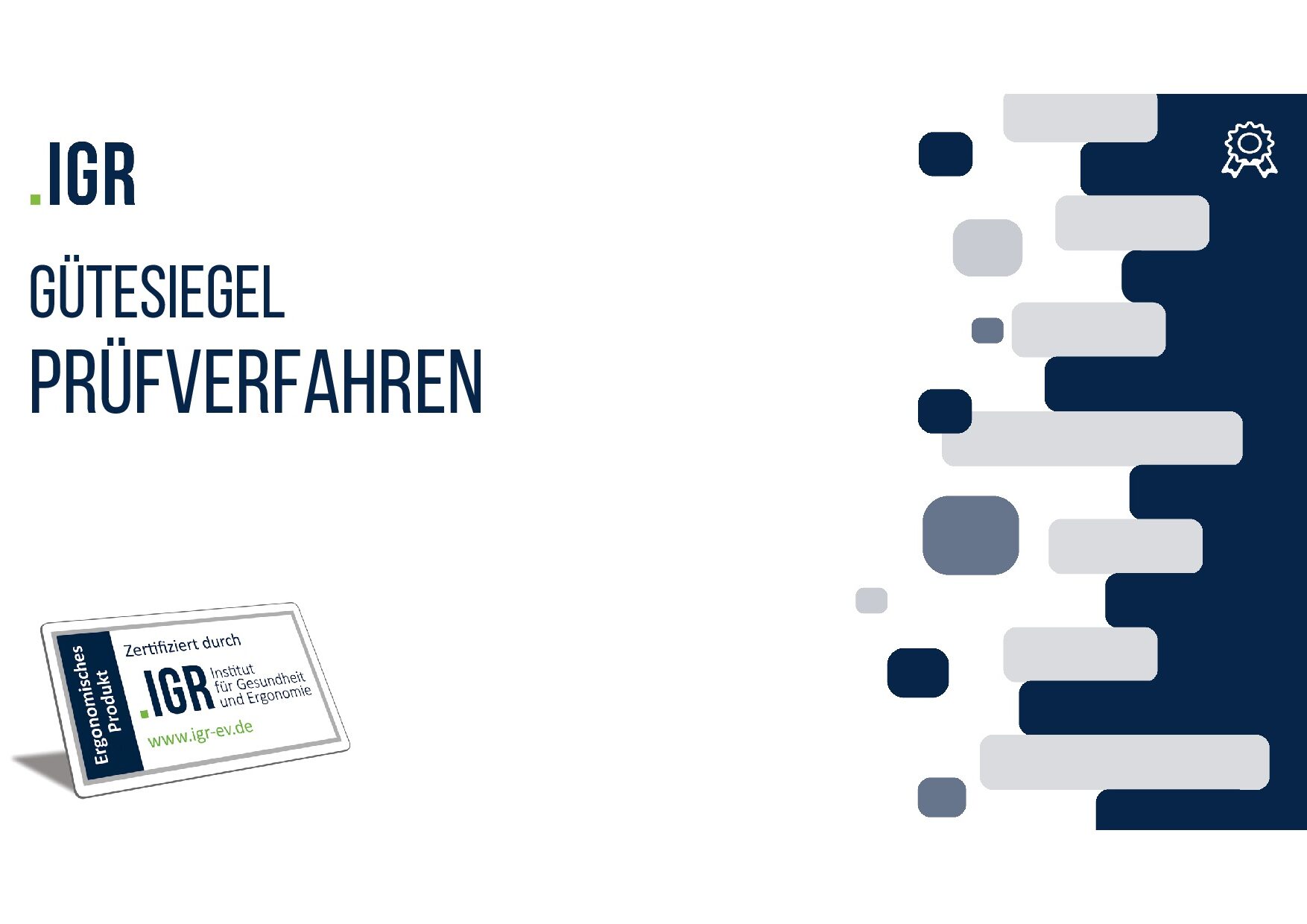
Overview of our test procedures
The product test applies the valid standards DIN EN ISO 26800 / EN ISO 15537 and determines the degree of adaptation of the product to the physical characteristics of the test person. You will find information on this below.
Products from the categories office & home office, garden & household, industry & trade, children & parents, kitchen & living, light, acoustics & climate, sleeping & reclining, shoes & insoles, sport & leisure and wellness & health are tested. In addition, software products and all services that focus on ergonomic benefits for the test person.
You can find detailed information on the IGR test procedure in our PDF.
The IGR in figures
The IGR as a neutral authority
We work independently by being committed solely to the applicable standards and our own benchmarks.
Networking at state and federal level
The IGR Institute for Health and Ergonomics is a partner of INQA (New Quality of Work Initiative, supported by the Federal Ministry of Labor and Social Affairs) and a founding member of the State Working Group on Prevention – a project of the Bavarian State Ministry of the Environment and Health.
Wide variety of ergonomic products
Office furniture, seating concepts, solutions for industry and workshops, sleeping systems and mattresses, ergonomic solutions for children, ergonomic accessories and all kinds of mobility products are tested. In addition, there are behavior-motivating software products and all services that focus on ergonomic added value for the user.
When it comes to product certification, we always work in partnership with our customers
We fulfill our task as a neutral auditing institute with great care. This also means that not every free preliminary test automatically leads to a test procedure, but may be rejected in advance due to a lack of quality aspects. Even if this initially causes disappointment for the manufacturer, there is still a great opportunity to further improve the product and ultimately achieve the desired result.
The same applies if a product fails the test procedure due to certain defects. Instead of leaving you alone with your complaints, we see ourselves as a partner who supports you with helpful solutions for the necessary improvements.

What our customers say

Making ergonomic quality visible
In globalized markets, transparent quality standards determine trust, market access and competitiveness. The topic of ergonomics is becoming increasingly important, especially in international trade – not least due to increasing requirements for health protection and user comfort.
The IGR certificate documents the ergonomic added value of a product. The seal of approval provides manufacturers with verifiable, neutral proof of quality that can be used worldwide in over 20 languages – for tenders, product labeling, B2B communication or export documentation, for example.
FAQ - Frequently asked questions
Whether office chairs, mattresses or computer keyboards – products and devices that people use should not only be safe, but also easily accessible and manageable. Regardless of the environment in which they are used (work, home, leisure), the underlying ergonomic principles are always the same. DIN EN ISO 26800, published in November 2011, summarizes these principles for all applications in one standard for the first time. The overview standard DIN EN ISO 26800 “Ergonomics – General approach, principles and concepts” was developed to provide a common framework for the key ergonomic principles and terms covered in other ergonomics standards. It presents generally applicable principles that are of fundamental importance in the design of products.
Further information: https://de.wikipedia.org/wiki/Ergonomie
The standard contains procedures for determining the composition of groups of people whose anthropometric characteristics (body measurements, body weight, etc.) are representative of the intended user population. In our tests, we take into account the corresponding measurements at the edges. In technical jargon, this is called 5 or 95% percentile unisex. Standards that manufacturers receive for the development of their products are based on the resulting values. The correct selection of test subjects ensures that the products can be used or adapted for the respective margins.
Further information: https://de.wikipedia.org/wiki/Anthropometrie
Each product / product series is tested against our defined minimum requirements.
The following tests form the basis of our ergonomic assessment:
- Operating and function test
- Adjustability and adaptation test
- Material and haptic evaluation
- Observation and posture test
These tests are carried out by qualified ergonomics testers under realistic conditions of use.
You can find more information about our test procedures here.
No, the IGR does not test products for material quality and safety, that is what testing institutes such as TÜV specialize in. When testing the IGR, the main focus is on ergonomics and the question of whether the product adapts to the anatomy of the person or whether the person has to adapt to the product.
However, all IGR-certified partners receive at least a 10% discount on GS certification at one of our partner testing institutes.
We need the product links, product data sheets or image data for the products to be tested so that we can carry out our free preliminary test. The more documents we have available, the faster the product inspection can be carried out.
After the free preliminary check, we will prepare an individual and binding offer for you. The number of products and the classification of these into the respective IGR product groups (0-3) are taken into account. The costs are always made up of a one-off inspection fee and the annual license fee.
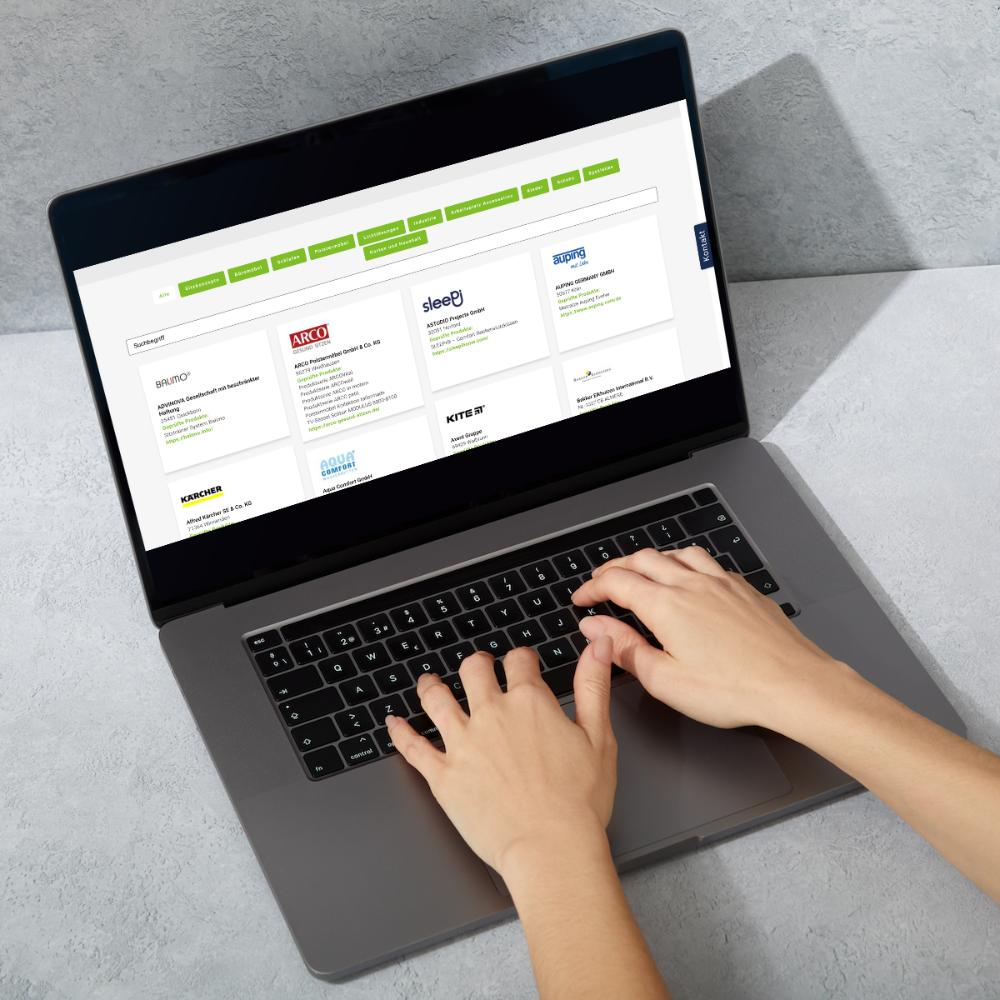
You can find all IGR-certified partners at:
The IGR tests all products where an ergonomic approach can be recognized in the products.
Products from the following areas are tested:
- Sport & Leisure
- Office & home office
- Sleeping & lying down
- Kitchen & Living
- Light, acoustics & climate
- Industry & trade
- Wellness & Health
- Children & Parents
- Shoes & insoles
- Garden & Household
All certified manufacturers and the associated categories can be found under: Certified products

Submit your products now for our free preliminary test:
These companies have already been successfully certified by the IGR
Many companies have already taken advantage of our certification process in recent years and are allowed to use the IGR seal of approval.